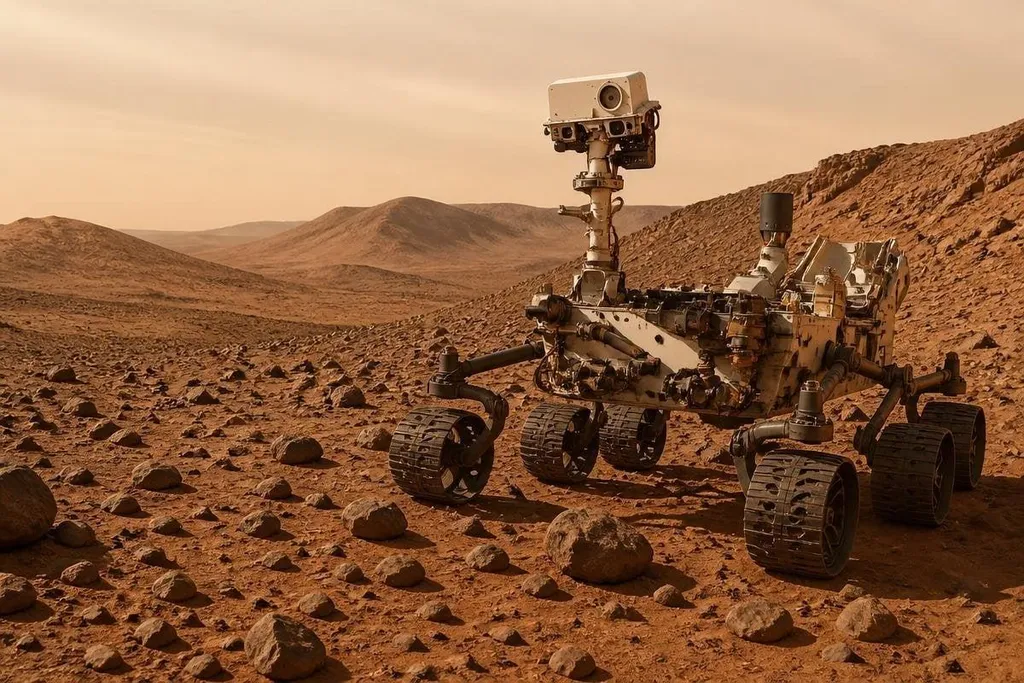
Mars rovers became famous by doing small jobs far from Earth: turning wheels, checking rocks, sending images, and surviving faults. Their public image grew from visible machine work, while their real value came from solving hard robotics problems without live control.
- Six wheels cross loose ground and small rocks
- Delayed radio signals prevent continuous joystick control
- Images make distant robot work easy to follow
A robot that works without a driver
A rover cannot wait for a person to steer every wheel. Radio signals take several minutes to travel between Earth and Mars, so each drive has a delay before the team sees the result.
That delay changes the design. The rover uses onboard software to check its path, avoid some hazards, and stop when its sensors detect trouble. People on Earth still plan routes and choose science targets, but the robot handles parts of the drive near the ground.
This pattern appears in many autonomous systems today. A warehouse robot, inspection machine, or field vehicle also needs to sense its space and react when the plan meets something unexpected. Mars made that need easy to see because a wrong move could end a mission millions of kilometres away.
The hardware became part of the story
The rovers also became memorable because their parts have clear jobs. A six-wheel layout gives the rover more contact with the ground, while rocker-bogie suspension lets the wheels move over uneven soil without needing springs at each wheel.
Cameras sit high on a mast so the rover can inspect the ground and plan a route. Other tools study rocks, soil, weather, or the rover’s own condition. A robotic arm moves instruments to a target, turning the vehicle into a mobile science lab.
Power shapes every decision. Earlier rovers used solar panels and had to manage dust, cold, and limited sunlight. Curiosity and Perseverance use radioisotope power systems, which produce heat and electricity without relying on daily sunlight. That lets their teams plan work around a steadier power source.
The hardware gives the public something concrete to follow. You can see a wheel mark, a drill hole, or a new image arrive from Mars. A software update is harder to picture. A rover leaving tracks is a machine doing work in public.
Names, images, and long missions
NASA gave the vehicles names such as Sojourner, Spirit, Opportunity, Curiosity, and Perseverance. Those names let people follow separate machines as individual workers rather than as one distant program.
The images mattered just as much. Each picture showed the mission’s place: a rocky plain, a dusty ridge, or a hole cut into stone. The photos also let people inspect the robot’s surroundings, which made the distance feel smaller without hiding the limits of the work.
NASA planned Opportunity for 90 Martian days, called sols. It worked for more than 14 years.
That long run did not make Mars easy to reach. It showed how careful driving, power control, fault handling, and team planning can keep a machine working far beyond its first target.
Those lessons also shape how Mars rover reports from Robot24.com can frame autonomy, remote operation, and field reliability by tying each idea to a named machine and a mission result.
I'd call Mars rovers robotics icons because they make system design visible. Their fame comes from a useful link between the machine people see and the engineering they rarely see.
What their example teaches robotics teams
A Mars rover offers a practical test for any remote robot project. Use this checklist before you judge a machine by a smooth demonstration:
- Define the delay: measure how long commands, sensor data, and emergency stops take to travel.
- Check local decisions: list which hazards the robot can detect without a remote operator.
- Track power limits: record what the machine can do when batteries, sunlight, or heat restrict work.
- Inspect recovery: find out what happens after a wheel slip, lost signal, bad sensor reading, or software fault.
- Follow the evidence: count completed tasks, useful data, and operating days rather than viewing a single drive.
These machines earned their place in robotics history through repeated work under tight limits. The next robot that reaches that level will need to show the same thing: useful tasks completed when nobody can take control at the exact moment trouble starts.